
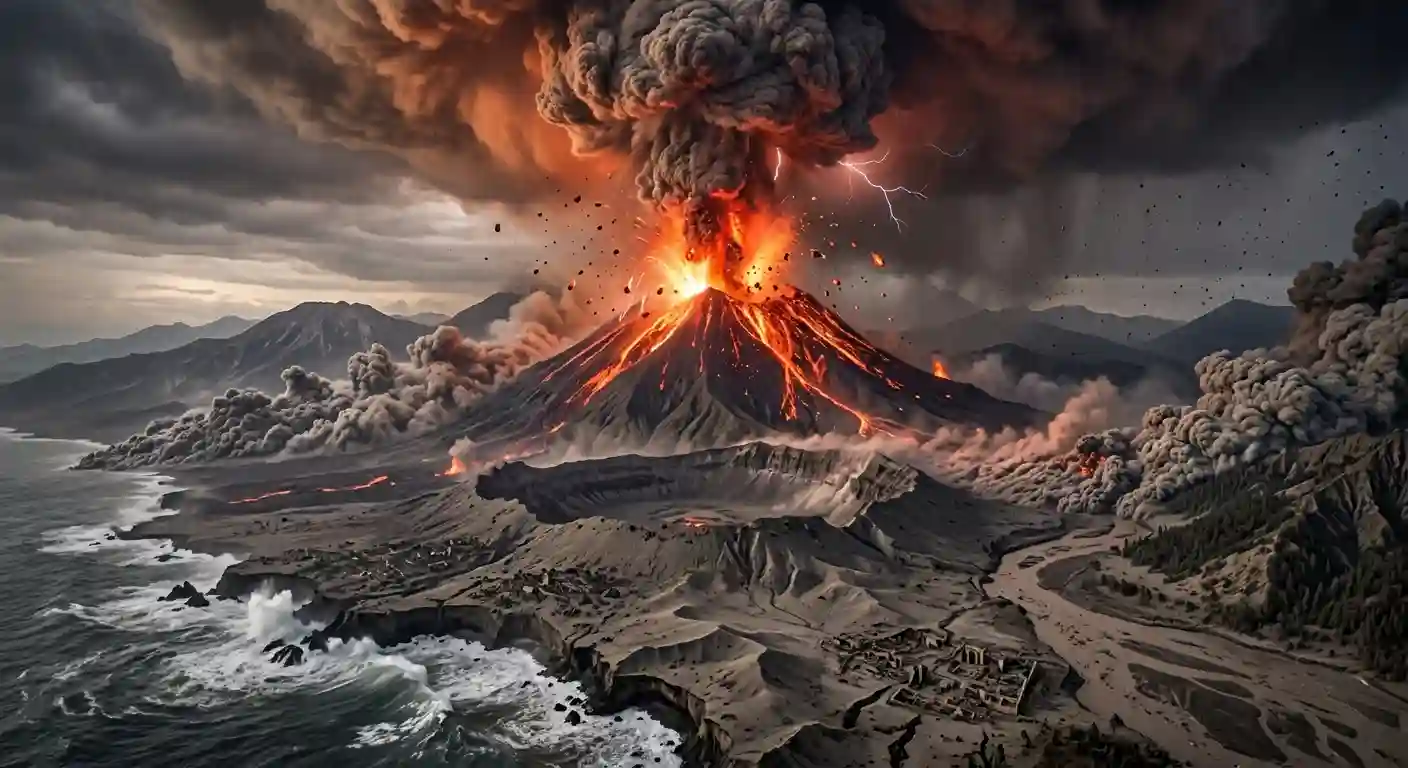
Volcanic eruptions are rated using the Volcanic Explosivity Index (VEI). This logarithmic scale runs from 0 (gentle lava flows) to 8 (supervolcanoes capable of global extinction events), where each whole number represents a tenfold increase in ejected material volume.
When ranking volcanic events across human history, two metrics tell the story: total volume of rock and ash erupted (explosive power) and human death toll.
The Most Powerful Explosive Eruptions in Recorded History
In modern and recorded history, no VEI 8 eruption has occurred; the largest events fall into the VEI 7 (super-colossal) and VEI 6 (colossal) categories.
| Date | Location | Volcanic Explosivity Index (VEI) | Material Ejected | Global & Regional Impact |
| April 10, 1815 | Mount Tambora, Indonesia | 7 | ~150 km³ | Largest recorded eruption; blasted 1,400 meters off the summit; caused global cooling. |
| c. 1600 BC | Thera (Santorini), Greece | 7 | ~60 km³ | Collapse of island caldera; generated 150-meter tsunamis across the Mediterranean. |
| 1257 | Mount Samalas, Indonesia | 7 | ~40 km³ | Injected massive sulfur clouds into the stratosphere, triggering a mini ice age. |
| August 27, 1883 | Krakatoa, Indonesia | 6 | ~21 km³ | Detonation heard 4,800 km away; generated 40-meter high tsunamis. |
| June 6, 1912 | Novarupta, Alaska, USA | 6 | ~30 km³ | Largest eruption of the 20th century; ejected 30 times more ash than Mt. St. Helens. |
| June 15, 1991 | Mount Pinatubo, Philippines | 6 | ~10 km³ | Lowered global average temperatures by 0.5°C over 15 months. |
1. Mount Tambora (1815) — VEI 7
On April 10, 1815, Mount Tambora on Sumbawa Island, Indonesia, detonated in the most explosive eruption in recorded human history. The volcano blasted approximately 150 cubic kilometers of pulverized rock and ash into the atmosphere, reducing the mountain’s peak elevation from 4,300 meters down to 2,850 meters.
The volcanic cloud blocked sunlight across the globe. Sulfur dioxide gas converted to sulfate aerosols in the stratosphere, triggering severe climate disruption. The following year, 1816, became known as the “Year Without a Summer”, bringing mid-summer snowstorms to North America and widespread crop failures across Europe and Asia.
2. Santorini / Minoan Eruption (c. 1600 BC) — VEI 7
Around 1600 BC, the volcanic island of Thera (modern-day Santorini, Greece) experienced an eruption that ejected roughly 60 cubic kilometers of magma. The center of the island collapsed into the sea, forming a vast underwater caldera.
The event produced tsunamis estimated at 35 to 150 meters in height that battered the coast of Crete, 110 kilometers to the south. This cataclysm crippled the maritime infrastructure of the Minoan civilization, contributing to its eventual decline.
3. Krakatoa (1883) — VEI 6
On August 27, 1883, the volcanic island of Krakatoa in the Sunda Strait exploded. The force of the final blast destroyed two-thirds of the island and produced the loudest sound in recorded history—heard over 4,800 kilometers away in Mauritius.
The collapse of the volcano into the ocean displaced massive volumes of water, triggering tsunamis up to 40 meters tall that destroyed 165 coastal villages. The atmospheric shockwave circled the globe four times.
The Deadliest Volcanic Eruptions in Human History
The deadliest volcanic disasters are driven by pyroclastic flows (fast-moving currents of superheated gas and rock), lahars (volcanic mudflows), and post-eruption famine.
| Date | Location | Estimated Fatalities | VEI | Primary Cause of Death |
| 1815 | Mount Tambora, Indonesia | 71,000–100,000+ | 7 | 11,000 from direct blast; 60,000+ from starvation and disease. |
| 1883 | Krakatoa, Indonesia | 36,417 | 6 | Tsunamis crashing into coastal Java and Sumatra. |
| May 8, 1902 | Mount Pelée, Martinique | 29,025–30,000 | 4 | Superheated pyroclastic surge destroying the city of Saint-Pierre. |
| November 13, 1985 | Nevado del Ruiz, Colombia | 23,000 | 3 | Volcanic mudflows (lahars) melting glaciers and burying Armero. |
| 1783–1784 | Laki (Grímsvötn), Iceland | 10,000+ (local) / 20,000+ (Europe) | 4 | Toxic fluorine gas, livestock poisoning, and regional famine. |
1. Mount Pelée (1902) — The 2-Minute Destruction
On May 8, 1902, Mount Pelée on the Caribbean island of Martinique erupted. A pyroclastic flow—a cloud of superheated gas, ash, and rock exceeding 1,000°C—rushed down the volcano at speeds over 160 km/h.
Within less than two minutes, the gas cloud engulfed the capital city of Saint-Pierre. Out of a population of roughly 30,000 residents, there were only 2 reported survivors.
2. Nevado del Ruiz (1985) — The Armero Tragedy
A relatively modest eruption (VEI 3) occurred at Nevado del Ruiz in Colombia on November 13, 1985. Hot pyroclastic material melted the volcano’s summit ice cap, generating massive torrents of water mixed with volcanic ash and clay.
These lahars funneled down river valleys at 50 km/h. The mudflows hit the town of Armero 48 kilometers away, burying it under 8 meters of mud and killing 23,000 of its 29,000 inhabitants.
Ancient Prehistoric Supervolcanoes (VEI 8)
While no VEI 8 super-eruption has occurred in written human history, prehistoric human populations experienced one massive event:
- Lake Toba Super-Eruption (Indonesia, ~74,000 Years Ago): Ejected approximately 2,800 km³ of material—nearly 20 times the volume of Mount Tambora. It caused a global volcanic winter lasting 6 to 10 years, which geneticists suggest reduced the early human population down to a few thousand breeding pairs.