
Real-time earthquakes from around the world, updated every minute. Filter by time and magnitude, or tap Near me to see quakes close to you.
Data: U.S. Geological Survey (USGS). Updates automatically every minute. Times shown in your local time.
What This Earthquake Map Shows
This page shows earthquakes happening around the world right now. The data comes from the U.S. Geological Survey (USGS) and refreshes every minute. Each circle on the map is one earthquake. Bigger circles mean stronger quakes, and the color shows the magnitude range. Use the buttons to switch between the past hour, the past 24 hours and the past 7 days. Press Near me to sort the list by distance from your location.
How Many Earthquakes Happen Every Day
More than most people think. The USGS locates around 55 earthquakes every day, close to 20,000 a year. Counting smaller ones, about 500,000 detectable earthquakes happen worldwide each year. Around 100,000 of those can be felt, and about 100 cause damage.
Here is the yearly average by size:
- Magnitude 8.0 and higher: about 1
- Magnitude 7.0 to 7.9: about 15
- Magnitude 6.0 to 6.9: about 130
- Magnitude 5.0 to 5.9: about 1,300
Was There an Earthquake Just Now?
If you felt shaking, check the list on the map. Quakes in the magnitude 3 to 4 range can be felt close to the epicenter, even though they are small. New quakes usually show up within a few minutes. The first magnitude is often adjusted slightly after USGS reviews the data, so a number may change by a tenth or two.
Understanding Magnitude
Magnitude is the number that describes the size of an earthquake. Each step up on the scale means the ground moves 10 times more and the quake releases about 32 times more energy. A magnitude 7 releases roughly 32 times the energy of a magnitude 6.
- Under 2.5: rarely felt
- 2.5 to 4.4: often felt, rarely causes damage
- 4.5 to 5.9: can damage weak buildings close to the epicenter
- 6.0 and higher: can cause serious damage
Where Earthquakes Happen
About 90 percent of all earthquakes happen along the Ring of Fire, the belt around the Pacific Ocean. It includes Japan, Indonesia, Chile, Alaska and the U.S. West Coast. Alaska has the most earthquakes of any U.S. state, while California has the most people living near major faults.
The Biggest Earthquakes in History
- 1960, Chile (M9.5): The strongest earthquake ever recorded.
- 1964, Alaska (M9.2): The strongest in U.S. history. The shaking lasted more than four minutes, and about 130 people died, mostly from the tsunami.
- 2004, Sumatra, Indonesia (M9.1): The Indian Ocean tsunami killed about 228,000 people in 14 countries.
- 2011, Tohoku, Japan (M9.1): About 18,400 people died or went missing, most of them from the tsunami.
- 1906, San Francisco (M7.9): About 3,000 deaths, with much of the damage caused by fire.
- 2010, Haiti (M7.0): More than 100,000 deaths by most estimates. The exact number is still debated.
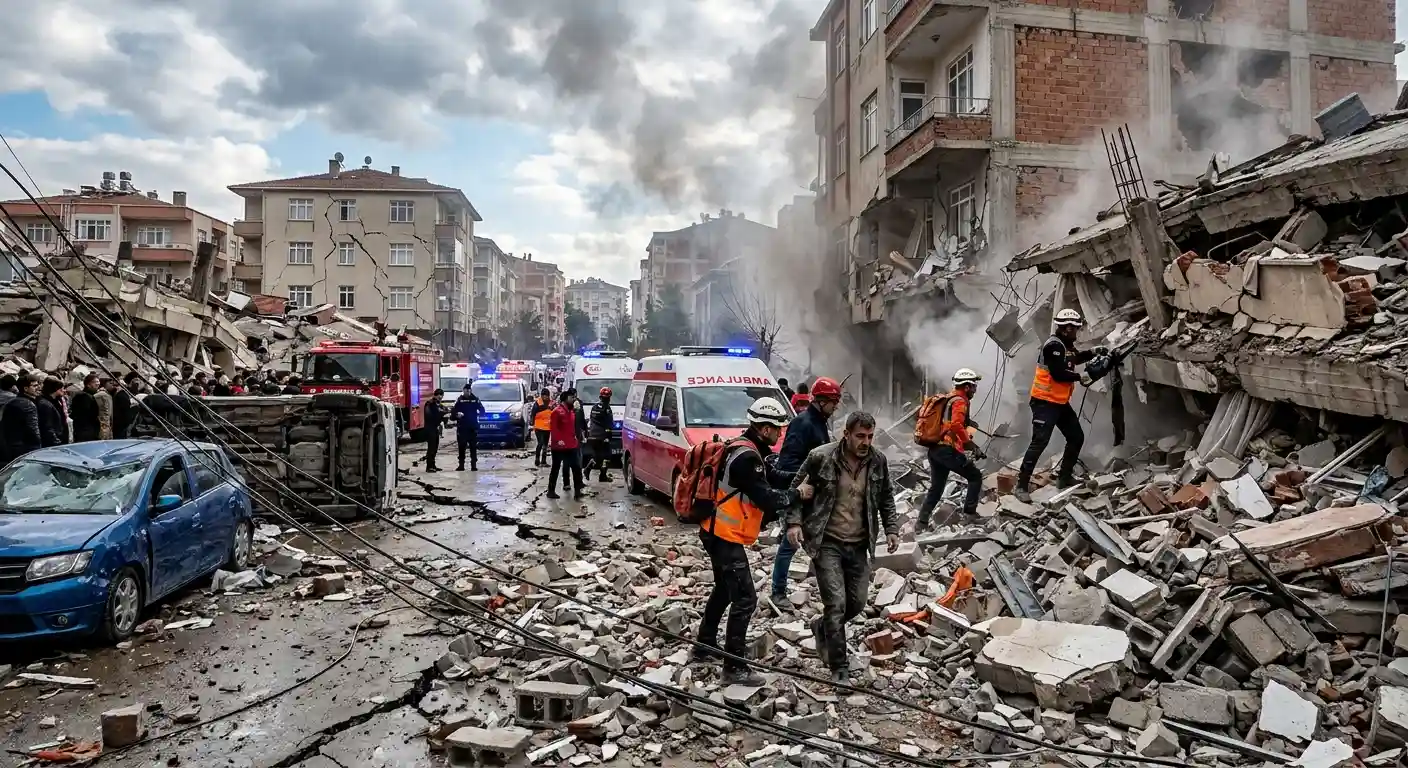
- 2023, Turkey and Syria (M7.8): More than 50,000 deaths.
The numbers show that magnitude is not everything. A shallow quake near a city can do more harm than a bigger one far out at sea.
What to Do During an Earthquake
Drop, Cover and Hold On. Get down on your hands and knees, cover your head and neck, and hold on to something sturdy until the shaking stops.
- Indoors: stay inside. Most injuries happen when people run outside.
- In bed: stay there and protect your head with a pillow.
- Outdoors: move away from buildings, trees and power lines.
- Near the coast: after strong shaking, go to high ground right away. Do not wait for an official warning.
After the Shaking Stops
Expect aftershocks. They can be strong enough to cause more damage. Check yourself and others for injuries, and look for damage to your home. If you smell gas, leave the building and call the gas company from outside.
Earthquake Near Me
Press Near me and allow location access. The map moves to your position, and the list shows each quake with its distance in miles. Your location is only used in your browser and is not stored.
Check the list on the map above. It shows every earthquake from the past hour, updated every minute. New quakes can take a few minutes to appear, and the magnitude may change slightly after USGS reviews the data.
The USGS locates around 55 earthquakes every day, close to 20,000 a year. Counting very small ones, about 500,000 detectable earthquakes happen worldwide each year, and around 100,000 of them can be felt.
No. Scientists cannot predict the exact time, place and size of an earthquake. They can estimate the long-term chance of a quake in a region, and some areas, like the U.S. West Coast, have early warning systems that send alerts seconds before the shaking arrives.
The 1960 earthquake in Chile, with a magnitude of 9.5. The strongest in U.S. history was the 1964 earthquake in Alaska, with a magnitude of 9.2.
Alaska has the most earthquakes of any state. California has the most earthquakes that affect large populations, because millions of people live near major faults.
Magnitude measures the size of the earthquake at its source, and each earthquake has one magnitude. Intensity describes how strong the shaking feels in a specific place, so it changes depending on how far you are and what kind of ground you are on.
Drop, Cover and Hold On. Get down on your hands and knees, cover your head and neck, and hold on to something sturdy until the shaking stops. Stay inside if you are indoors, and move away from buildings and power lines if you are outside.