
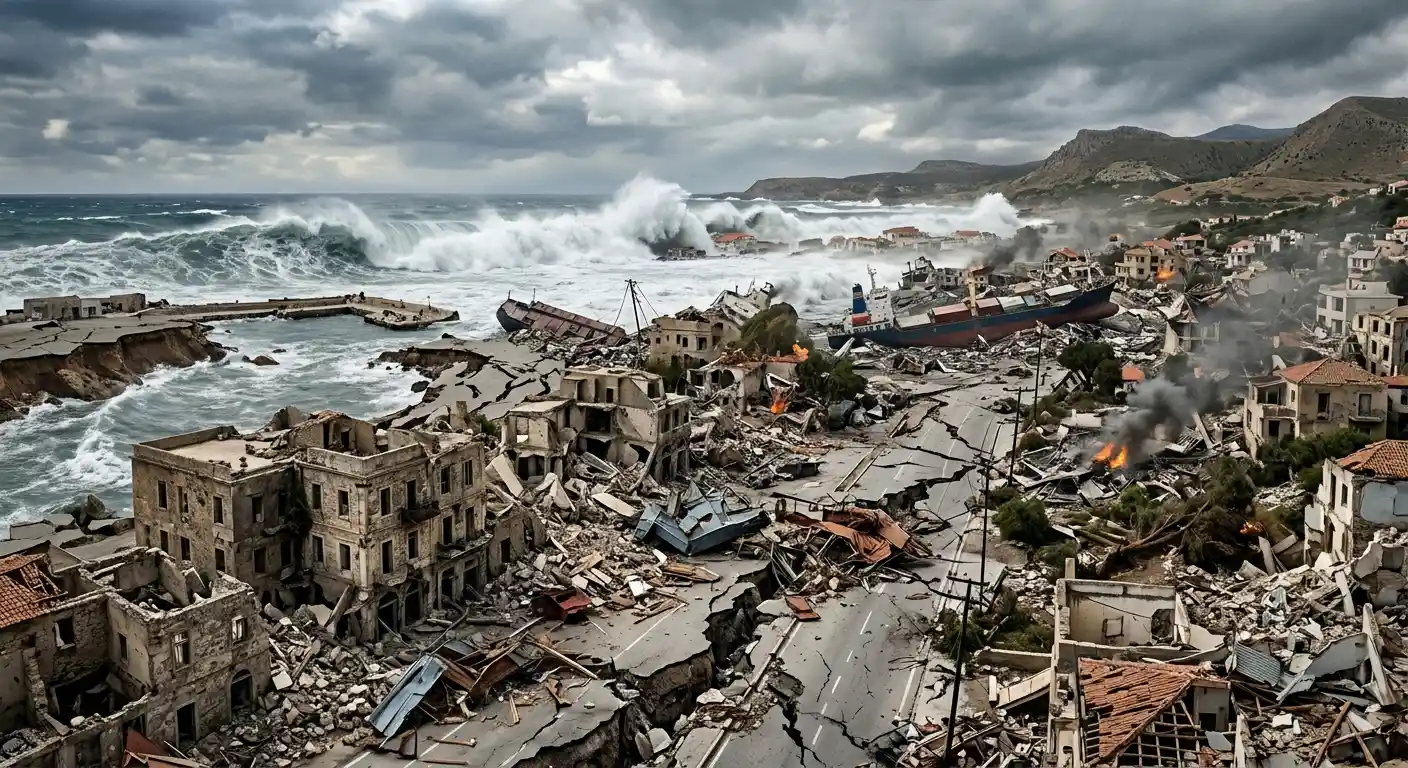
Earthquakes rank among the most destructive forces on Earth. Since modern seismology began around 1900, scientists have used the moment magnitude scale to record the energy released during seismic events. When assessing earthquakes across human history, two main metrics define their scale: magnitude (the physical energy released) and death toll (the human cost).
The Strongest Earthquakes Ever Recorded
The power of an earthquake is measured on a logarithmic scale. Every whole-number increase in magnitude represents about 32 times more energy released.
| Date | Location | Magnitude | Key Statistics & Impact |
| May 22, 1960 | Valdivia, Chile | 9.5 | Largest ever recorded. Ruptured 1,000 km of fault line; triggered a 25-meter ocean tsunami; left 2 million homeless. |
| March 27, 1964 | Prince William Sound, Alaska | 9.2 | Ground shook for 4.5 minutes. Caused vertical land shifts up to 11.5 meters. |
| December 26, 2004 | Sumatra, Indonesia | 9.1 | Fault length of 1,300 km. Generated tsunami waves up to 30 meters high across 14 countries. |
| March 11, 2011 | Tōhoku, Japan | 9.1 | Shifted Japan’s main island 2.4 meters east and tilted Earth’s axis by 10 to 25 cm. |
| November 4, 1952 | Kamchatka, Russia | 9.0 | Triggered 13-meter waves reaching Hawaii and New Zealand. |
1. The Great Chilean Earthquake (1960) — Magnitude 9.5
On May 22, 1960, the strongest earthquake in recorded history struck southern Chile near Valdivia. The tectonic rupture spanned roughly 1,000 kilometers along the Nazca and South American plate boundary.
The earthquake triggered a ocean-wide tsunami. Waves traveling at 800 km/h hit Hilo, Hawaii, 15 hours later with heights of 10.7 meters. Over 2 million people were left homeless, with economic damage exceeding $550 million ($5.5 billion in current dollars).
2. The Great Alaska Earthquake (1964) — Magnitude 9.2
Occurring on Good Friday, March 27, 1964, in Prince William Sound, Alaska, this magnitude 9.2 event holds the record for the strongest earthquake in North American history.
The shaking lasted 4 minutes and 30 seconds. Soil liquefaction caused massive landslides, sinking entire neighborhoods in Anchorage. Vertical land displacement raised parts of the seafloor by 11.5 meters while dropping other areas by 2 meters.
3. The Indian Ocean Tsunami (2004) — Magnitude 9.1
On December 26, 2004, a subduction zone quake off the coast of Sumatra, Indonesia, released energy equivalent to 23,000 Hiroshima-type atomic bombs. The fault rupture stretched 1,300 kilometers—the longest rupture length ever observed.
The resulting tsunami struck 14 countries, killing an estimated 227,898 people. It remains the deadliest tsunami in human history.
The Deadliest Earthquakes in History
High magnitude does not always mean high loss of life. Population density, building construction, and local soil conditions dictate casualty numbers.
| Date | Location | Estimated Deaths | Magnitude | Primary Cause of Destruction |
| January 23, 1556 | Shaanxi, China | 830,000 | ~8.0 | Collapse of yaodong (cave homes carved into soft loess soil). |
| July 28, 1976 | Tangshan, China | 242,000–300,000 | 7.6 | Structural collapse of unreinforced masonry across an industrial hub. |
| December 16, 1920 | Haiyuan, China | 273,000 | 7.8 | Over 670 major landslides across soft soil regions. |
| May 21, 526 | Antioch (Turkey) | 250,000 | ~7.0 | Fires following structural collapse in a crowded ancient city. |
| October 11, 1138 | Aleppo, Syria | 230,000 | ~7.1 | Destruction of medieval stone fortifications and city walls. |
1. Shaanxi Earthquake (1556) — 830,000 Deaths
On January 23, 1556, during the Ming Dynasty, an earthquake struck Shaanxi Province, China. Most of the local population lived in yaodongs—artificial caves dug into soft loess cliffs.
When the ground shook, the cliffs collapsed, burying hundreds of thousands of residents instantly. The event killed approximately 60% of the regional population across an 840-kilometer zone.
2. Tangshan Earthquake (1976) — 242,000+ Deaths
At 3:42 AM on July 28, 1976, a 7.6-magnitude quake struck Tangshan, an industrial city in Hebei, China. The epicenter was directly underneath a city built on soft alluvial soil.
Within 10 seconds, 85% of the city’s unreinforced brick buildings collapsed while people slept. Official figures recorded 242,769 deaths, though independent estimates place the total over 300,000.
Energy Comparison Summary
To put tectonic forces in context, seismic energy scales rapidly:
- Magnitude 7.0: Releases energy equivalent to ~480,000 tons of TNT.
- Magnitude 8.0: Releases energy equivalent to ~15,000,000 tons of TNT.
- Magnitude 9.5 (Chile 1960): Released over 2,700,000,000 tons of TNT equivalent.