
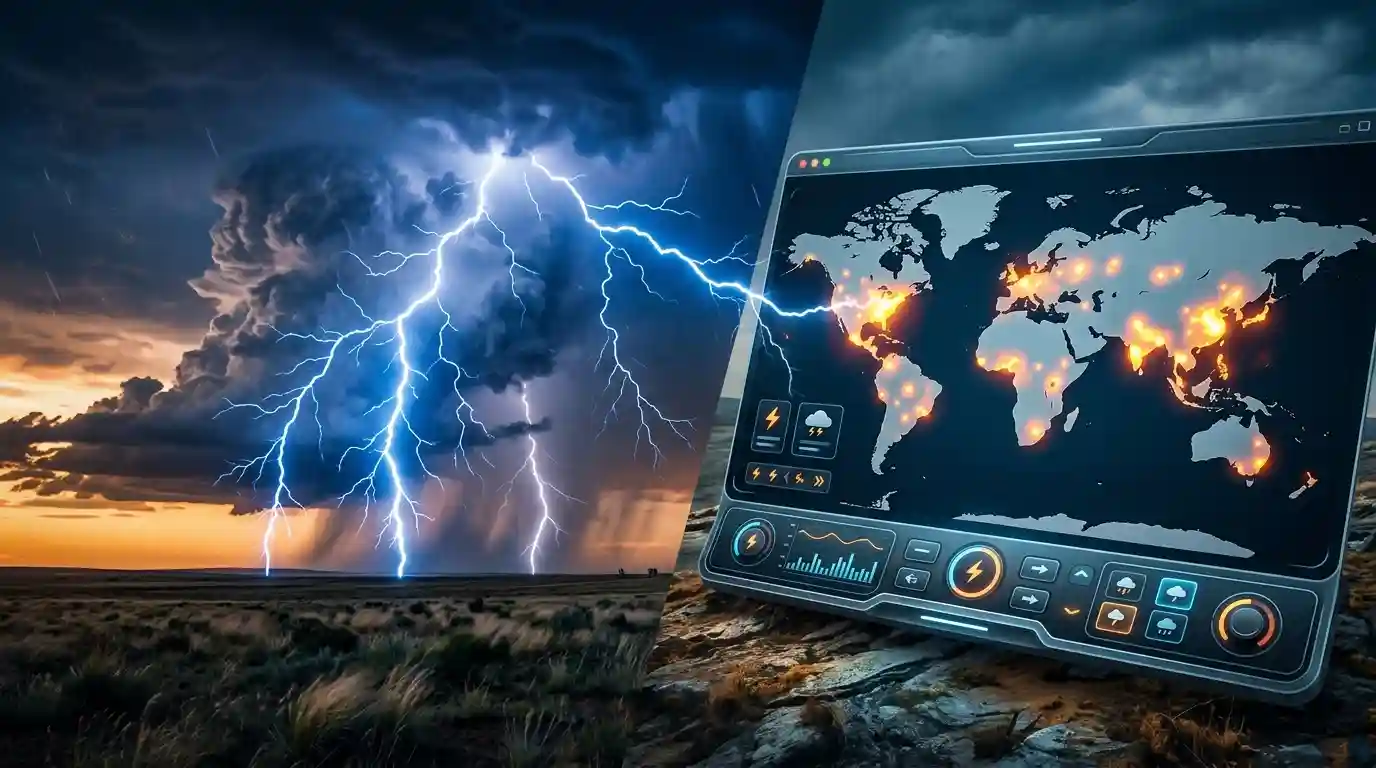
Track real-time lightning strikes, active thunderstorms, and severe weather warnings worldwide with our interactive live lightning map.
Data source: Global VLF lightning detection network feed. Updated continuously in real-time.
The Power of Global Lightning
Earth is struck by lightning approximately 44 to 50 times every single second, translating to a staggering 1.4 billion flashes globally every year. This constant electrical bombardment is driven by intense thermodynamic processes within towering cumulonimbus clouds. Inside these storm cells, powerful updrafts and downdrafts carry moisture and ice crystals at speeds exceeding 40 miles per hour.
These turbulent collisions strip electrons from ice particles, creating a massive dipole structure within the cloud: positive ions accumulate near the freezing upper anvil, while negative charges pool heavily near the base. When the electrical potential gradient between the cloud base and the Earth's surface surpasses the dielectric breakdown threshold of air—typically around 3 million volts per meter—an invisible column of ionized air called a stepped leader surges downward.
Once it connects with an upward streamer rising from the ground, the circuit closes, and a catastrophic return stroke fires upward at roughly one-third the speed of light. This massive discharge superheats the surrounding air channel to approximately 30,000 Kelvin (53,500°F) in less than a microsecond. This sudden, explosive thermal expansion generates a shockwave that propagates outward as thunder, audible up to 10 to 15 miles away under optimal atmospheric conditions.
How VLF Sensor Networks Triangulate Strikes in Real Time
Detecting and mapping these violent atmospheric events across open oceans and remote continents requires high-precision physics and global sensor cooperation. Modern community-driven tracking networks rely heavily on Very Low Frequency (VLF) radio receivers operating in the 3 to 30 kHz frequency band.
- Electromagnetic Propagation: Every lightning discharge acts as a massive natural radio transmitter, broadcasting powerful electromagnetic pulses that bounce efficiently between the Earth's surface and the lower ionosphere (known as the Earth-ionosphere waveguide). This ducting effect allows VLF signals to travel thousands of miles without dissipating completely.
- Time-of-Arrival (ToA) Precision: Independent ground stations equipped with specialized antenna coils and GPS-synchronized timing clocks record the exact microsecond an electromagnetic wavefront passes their location.
- Hyperbolic Triangulation: By cross-referencing timestamps from at least 4 to 6 separate monitoring stations, central servers use hyperbolic multilateration algorithms to calculate the exact geographic coordinates of the strike. This triangulation achieves a spatial accuracy of 100 to 500 meters globally.
Because lightning occurs predominantly in tropical regions—such as the Congo Basin, the Amazon, and Southeast Asia—deploying dense arrays of ground sensors in populated areas while leveraging long-range VLF propagation allows networks to map remote oceanic storms with remarkable reliability.
Severe Weather Risks, Wildfires, and Infrastructure Vulnerabilities
Lightning is not merely an atmospheric spectacle; it represents a severe, recurring hazard to human life, natural ecosystems, and modern technological infrastructure.
- Wildfire Ignition: In dry summer months and arid climates, cloud-to-ground lightning accounts for over 50% of all major wildfires in regions like the western United States, Canada, and boreal forests. Unlike positive cloud-to-ground strikes—which carry enormous currents and linger longer, making them primary fire starters—negative strokes are faster but still capable of igniting dry timber.
- Power Grid and Telecommunications Failures: A single direct lightning strike on a high-voltage transmission line can induce electrical surges exceeding 100,000 amperes. These surges can instantly blow industrial transformers, fry substation electronics, and trigger multi-city blackouts if surge protection fails.
- Aviation Safety Standards: Commercial aircraft are struck by lightning on average once per year per plane. Modern airliners are meticulously engineered with aluminum skins or conductive carbon-fiber composites paired with static wicks, allowing the intense electrical current to safely travel across the fuselage and discharge into the air without penetrating the cabin or disrupting sensitive flight control avionics.
Lightning FAQ
Earth is struck by lightning approximately 44 to 50 times every single second, resulting in roughly 1.4 billion flashes globally every year.
Turbulent updrafts and downdrafts in cumulonimbus clouds cause ice crystals and water droplets to collide violently, separating electrical charges and creating massive voltage gradients that discharge as lightning.
By cross-referencing signal arrival timestamps from at least 4 to 6 independent ground stations, hyperbolic triangulation algorithms can pinpoint strike locations within an accuracy of 100 to 500 meters.
A lightning discharge superheats the surrounding air channel to approximately 30,000 Kelvin (about 53,500°F) in less than a microsecond, causing an explosive thermal expansion that creates thunder.
Yes, commercial aircraft are struck roughly once a year per plane, but they are engineered with conductive skins and static wicks that safely dissipate the electrical current around the exterior.
A direct cloud-to-ground strike on a high-voltage transmission line can induce massive electrical surges exceeding 100,000 amperes, capable of damaging transformers if proper surge protection fails.