
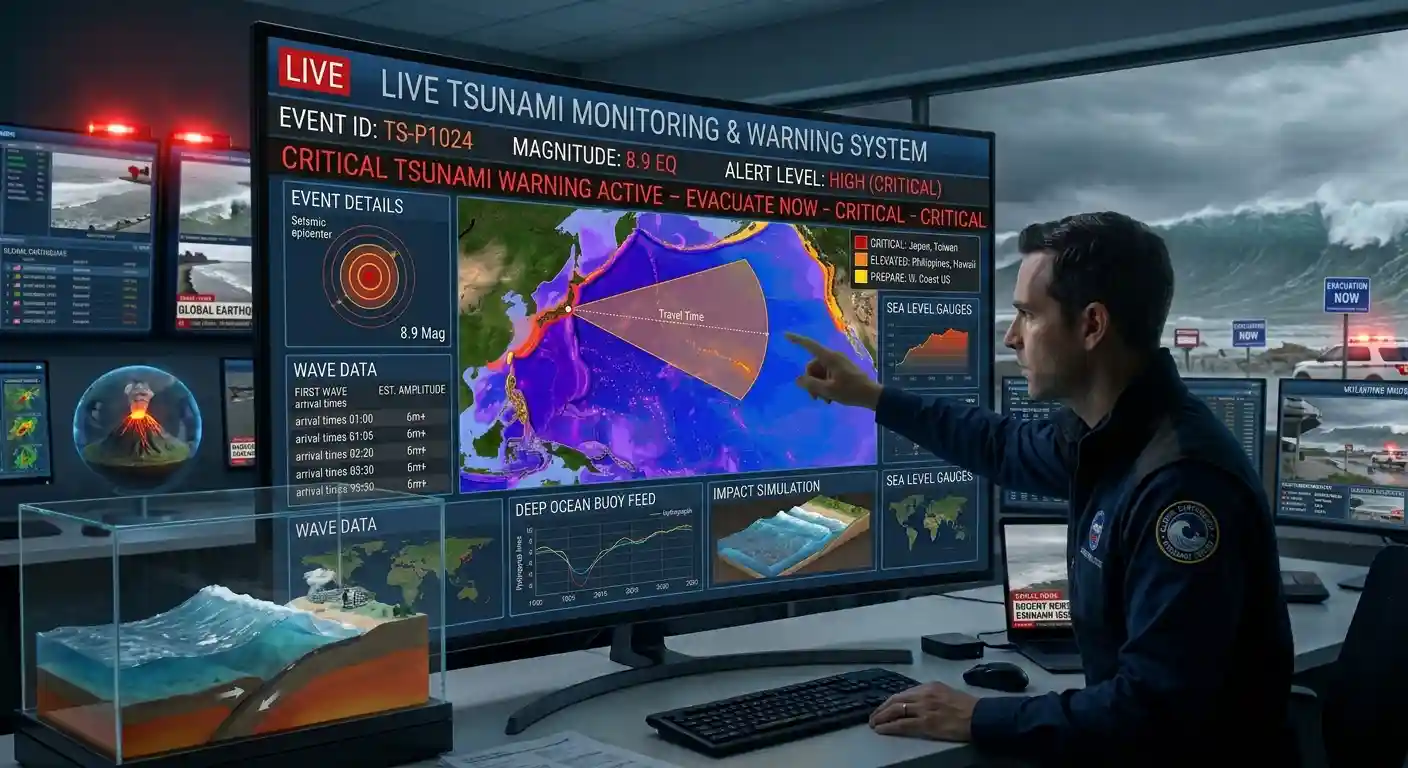
Official tsunami messages and large earthquakes worldwide, updated every 2 minutes.
Earthquakes and tsunami flags: U.S. Geological Survey. Official messages: NOAA Tsunami Warning Centers (PTWC and NTWC) and the U.S. National Weather Service. Outside the United States, official warnings come from national agencies. For official information, visit tsunami.gov. This page does not replace official warnings. If you feel strong shaking near the coast, move to high ground at once.
What This Tsunami Map Shows
This page shows official tsunami messages and large earthquakes around the world. The earthquake data comes from the U.S. Geological Survey and refreshes every 2 minutes. A blue ring around an earthquake means NOAA’s tsunami warning centers issued a message for it. The boxes at the top show the latest messages from the Pacific Tsunami Warning Center and the National Tsunami Warning Center, plus any active tsunami warnings, advisories and watches in the United States. Use the filters to change the time period or the minimum magnitude.
Is There a Tsunami Warning Right Now?
Check the boxes above the map. If a warning is active, it appears there in red. A message marked as “Information” means a large earthquake happened, but no tsunami threat was found. Outside the United States, official warnings come from national agencies, so check your local authorities.
Types of Tsunami Messages
- Information statement: An earthquake happened, and there is no threat or only a small one.
- Watch: A distant event may affect your area. Stay alert and be ready to act.
- Advisory: Strong currents and waves are expected. Stay out of the water and away from beaches and harbors.
- Warning: Dangerous flooding is expected. Move to high ground right away.
What Causes a Tsunami
Most tsunamis are caused by large earthquakes under the ocean, usually magnitude 7 or higher, where the seafloor moves up or down. Underwater landslides and volcanic eruptions can also cause them. About 80 percent of tsunamis happen in the Pacific Ocean, along the Ring of Fire. Not every large earthquake causes a tsunami. It depends on the depth, the location and how the seafloor moves.
How Fast Do Tsunamis Travel
In deep water, a tsunami can travel at about 500 mph (800 km/h), as fast as a jet plane. The wave is only a foot or two high out at sea, so ships rarely notice it. Near the coast the water slows down and the wave grows. A tsunami is not a single wave. It is a series of waves that can arrive 10 minutes to an hour apart, and the first wave is often not the largest.
The Deadliest Tsunamis in Recent History
- Indian Ocean, 2004: A magnitude 9.1 earthquake off Sumatra caused a tsunami that killed about 228,000 people in 14 countries.
- Japan, 2011: A magnitude 9.1 earthquake caused waves of up to 40 meters in some places. About 18,400 people died or went missing.
- Chile, 1960: The strongest earthquake ever recorded, magnitude 9.5. The tsunami crossed the Pacific and killed people in Hawaii and Japan.
- Alaska, 1964: A magnitude 9.2 earthquake, with about 130 deaths, including in California and Oregon.
- Sulawesi, Indonesia, 2018: A magnitude 7.5 earthquake caused a tsunami and landslides that killed more than 4,000 people.
- Tonga, 2022: A volcanic eruption caused a tsunami that was recorded across the Pacific.
Warning Signs
You may not get an official message in time if the earthquake is close to the coast. Natural warning signs are strong shaking that lasts a long time, a sudden rise or drop in the sea level, and a loud roar from the ocean. If you see any of them, do not wait for an alert.
What to Do
Move to high ground right away, at least 100 feet (30 meters) above sea level, or go at least 1 mile (2 km) inland. Go on foot if you can, because roads can fill up. Stay away from the coast until officials say it is safe, since later waves can be bigger. EarthInformer is an information site and does not issue official warnings.
Source: Earthquake data from the U.S. Geological Survey (USGS). Tsunami messages from NOAA’s tsunami warning centers and the National Weather Service.
FAQ
Check the boxes above the map. Active warnings, advisories and watches appear there, together with the latest messages from NOAA’s tsunami warning centers. For other countries, check your national agency.
A watch means a distant event may affect your area. An advisory means strong currents and waves are expected, so stay out of the water. A warning means dangerous flooding is expected, and you should move to high ground.
Most tsunamis are caused by large earthquakes under the ocean, usually magnitude 7 or higher. Underwater landslides and volcanic eruptions can also cause them.
About 500 mph (800 km/h) in deep ocean. It slows down near the coast, where the wave grows taller.
It depends on the distance. Near the earthquake, a tsunami can reach the coast in minutes. Across an ocean, it can take many hours.
No. A tsunami needs a large earthquake that moves the seafloor, usually a shallow one under the ocean. Many large earthquakes on land or deep underground do not cause one.
Move to high ground right away, at least 100 feet (30 meters) above sea level or 1 mile (2 km) inland. Do not wait for an official warning, and stay away from the coast until officials say it is safe.