
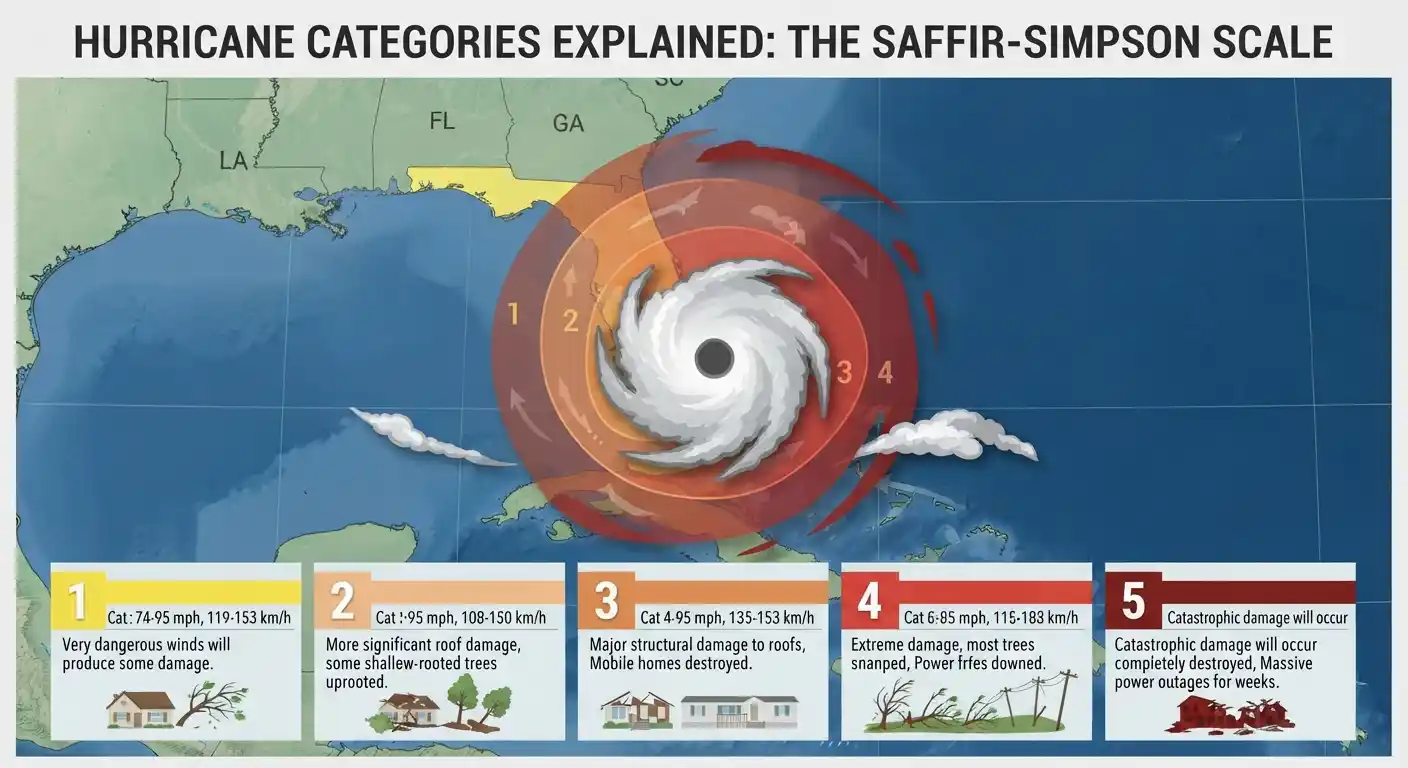
When a hurricane forms, the news quickly gives it a number from 1 to 5. That number is its category, and it comes from the Saffir-Simpson Hurricane Wind Scale. This guide explains what each category means, what the scale leaves out, and why a “weak” hurricane can still be deadly. You can follow active storms and their categories on our hurricane tracker.
What the Saffir-Simpson Scale Measures
The scale rates a hurricane by one thing only: its maximum sustained wind speed. “Sustained” means the average wind over one minute, not a single gust.
The scale applies to storms in the Atlantic and the eastern and central Pacific. Other regions use different names and scales, which we cover below.
The Five Categories
Before a storm becomes a hurricane, it passes through earlier stages:
- Tropical depression: winds up to 38 mph (62 km/h)
- Tropical storm: winds of 39 to 73 mph (63 to 118 km/h). This is when a storm gets a name.
Once winds reach 74 mph (119 km/h), the storm is a hurricane:
- Category 1: 74 to 95 mph (119 to 153 km/h). Very dangerous winds. Expect damage to roofs, siding and gutters, fallen tree branches and power outages that can last days.
- Category 2: 96 to 110 mph (154 to 177 km/h). Extremely dangerous winds. Expect major roof and siding damage, many uprooted trees and widespread power loss.
- Category 3: 111 to 129 mph (178 to 208 km/h). Devastating damage. Well-built homes can suffer major damage, and electricity and water may be out for days or weeks. This is the first “major” hurricane.
- Category 4: 130 to 156 mph (209 to 251 km/h). Catastrophic damage. Homes can lose roofs and some exterior walls, and areas may be unlivable for weeks or months.
- Category 5: 157 mph (252 km/h) or higher. Catastrophic damage. A high percentage of homes can be destroyed, and the area may be uninhabitable for a long time.
What Is a Major Hurricane?
Any hurricane of Category 3 or higher is called a major hurricane. These storms cause most hurricane damage, even though they make up a smaller share of all hurricanes.
Why Category Does Not Equal Danger
This is the most important point in this guide. The category tells you only about wind. It does not tell you about the other hazards:
- Storm surge: a wall of ocean water pushed ashore. It causes most hurricane deaths, and it depends on storm size, speed and coastline shape, not just category.
- Rainfall and flooding: a slow storm can drop huge amounts of rain on one area. Hurricane Harvey in 2017 came ashore as a Category 4, but its record rain over Texas caused the worst damage.
- Tornadoes: hurricanes often spawn them, mostly in the outer bands.
Hurricane Katrina in 2005 shows this well. It weakened to a Category 3 before landfall, but its huge size and storm surge devastated the Gulf Coast. Never judge a storm by its number alone.
Winds Get Worse Faster Than You Think
The jump between categories is bigger than it looks. Damage rises steeply as wind speed increases, so a Category 4 does far more than twice the damage of a Category 2. This is why a storm that strengthens quickly is so risky.
Forecasters call this rapid intensification, usually defined as a wind increase of at least 35 mph in 24 hours. When it happens close to land, people have less time to prepare.
Hurricanes, Typhoons and Cyclones
These are the same type of storm with different names, depending on where they form:
- Hurricane: Atlantic Ocean and eastern and central Pacific
- Typhoon: northwestern Pacific
- Cyclone: Indian Ocean and South Pacific
The Saffir-Simpson scale is used for hurricanes. Other regions use their own agencies and scales, so a “category” can mean something slightly different there.
How to Use Category Information
- Check the category, but also the size, speed and rainfall forecast.
- Learn your surge risk. Local officials can tell you whether your home is in an evacuation zone.
- Follow the forecast, not just the current number. A Category 2 today could be a Category 4 by landfall.
- Prepare for the hazards of the whole storm, not only the wind rating.
To see where a storm is heading, read our guide on how to read a hurricane cone and track. For rain and flooding, check the live radar and the flood map.
The Saffir-Simpson scale is a quick way to rate a hurricane’s wind. It is useful, but it is only one part of the danger. Surge, rain and storm size often matter just as much, so use the category together with official warnings and local guidance.