
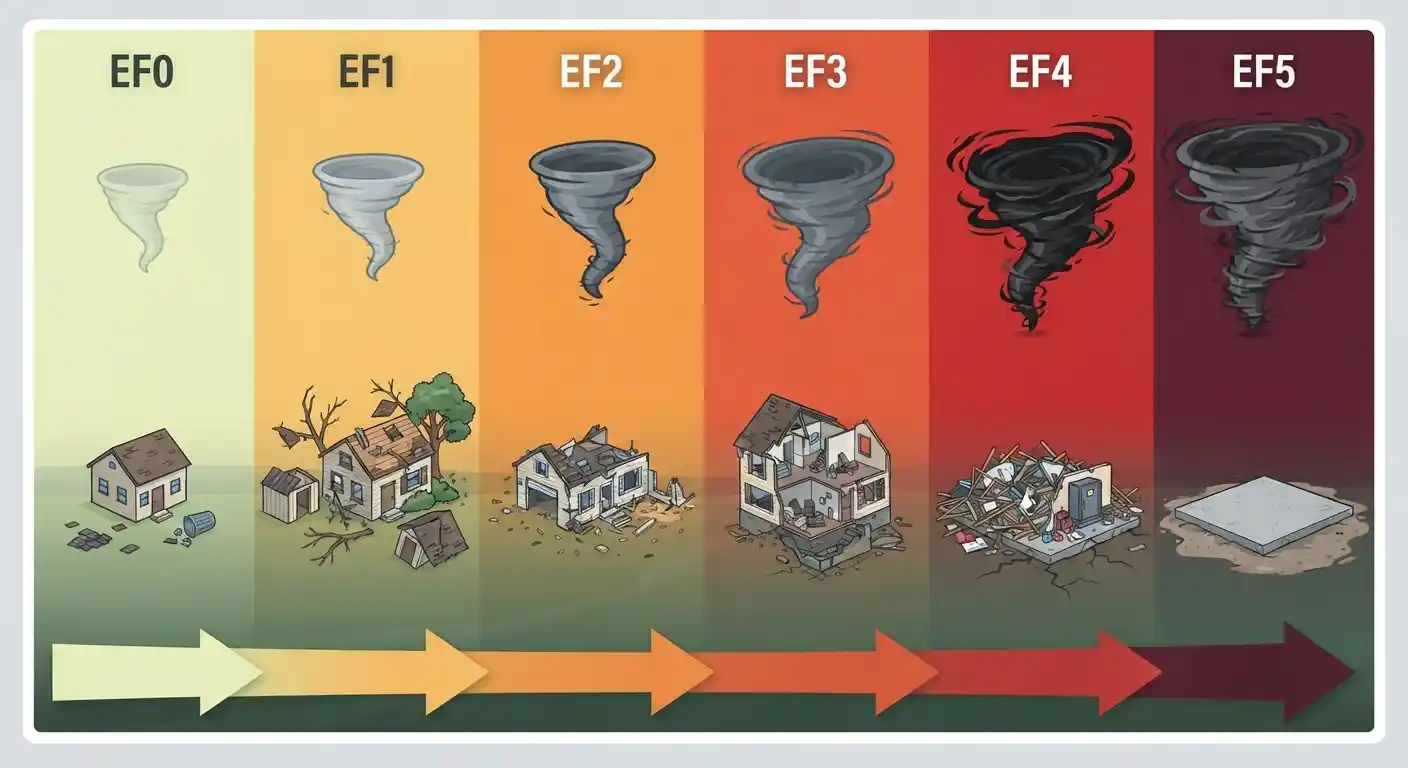
After a tornado, news reports quickly say it was an “EF2” or an “EF4”. That rating comes from the Enhanced Fujita Scale, and it tells you how violent the tornado was. This guide explains how the scale works, what each rating means, and what it does not measure. You can follow tornado alerts on our tornado tracker.
What Is the Enhanced Fujita Scale?
The Enhanced Fujita (EF) Scale rates tornadoes from EF0 (weakest) to EF5 (strongest). It replaced the original Fujita Scale, created by Dr. Ted Fujita in 1971, and has been used in the United States since February 2007. Canada uses its own version.
The scale was updated because the original often overestimated wind speeds and did not account well for how well a building was constructed.
How Tornadoes Are Rated
A tornado is rated after it has passed, not while it is happening. Weather service teams survey the damage and compare it with a list of damage indicators, such as homes, barns, schools, trees and towers. For each, they judge how severe the damage is.
The rating reflects the worst damage found along the whole path. A tornado that hits open fields for 20 miles and then destroys one house can still earn a high rating from that one house.
Wind speeds are then estimated from the damage. They are estimates, not direct measurements.
The Six Ratings
- EF0: 65 to 85 mph (105 to 137 km/h). Light damage. Shingles peel off, gutters and siding are damaged, and branches break.
- EF1: 86 to 110 mph (138 to 177 km/h). Moderate damage. Roofs are badly stripped, mobile homes can be overturned and moving cars can be pushed off roads.
- EF2: 111 to 135 mph (178 to 217 km/h). Considerable damage. Roofs are torn off well-built homes, mobile homes are destroyed and large trees are snapped or uprooted.
- EF3: 136 to 165 mph (218 to 266 km/h). Severe damage. Entire stories of well-built houses can be destroyed, and trains can be overturned.
- EF4: 166 to 200 mph (267 to 322 km/h). Devastating damage. Well-built homes can be leveled, and cars are thrown.
- EF5: over 200 mph (over 322 km/h). Incredible damage. Strong homes can be swept off their foundations, and steel-reinforced buildings can be badly damaged.
How Common Is Each Rating?
Most tornadoes are weak. Roughly three out of four are rated EF0 or EF1. At the other end, violent tornadoes (EF4 and EF5) are only about 1 percent of all tornadoes, but they cause a large share of tornado deaths.
EF5 tornadoes are very rare. The first one under the new scale was Greensburg, Kansas, in 2007. Other well-known EF5 tornadoes include Joplin, Missouri, in 2011 and Moore, Oklahoma, in 2013.
What the Scale Does Not Tell You
The EF rating is useful, but it has limits:
- It does not measure size. A narrow EF4 can be less widespread than a wide EF2. Path length and width are recorded separately.
- It depends on what was hit. A very strong tornado in open country can get a low rating because there was little to damage.
- It is a rating after the fact. It cannot tell you how strong a tornado will be while it is forming.
- Even weak tornadoes can kill. Flying debris can hurt or kill people in any tornado. Do not dismiss an EF0 or EF1.
Why the Rating Is Not the Same as a Warning
The EF scale is separate from alerts. A tornado warning is based on a tornado being seen or detected on radar, not on a rating. When a warning is issued, you should take shelter no matter how strong the tornado may turn out to be. To learn what each alert means, read our guide on tornado watch vs warning.
Can a Rating Change Later?
Yes. Ratings can be changed after further study, for example if new evidence, photos or engineering analysis show the damage was caused by stronger or weaker winds than first thought. Early ratings are preliminary.
Tornadoes and Radar
Some tornadoes are measured directly by mobile Doppler radar, which can record wind speeds inside the storm. Those readings can be higher than the speeds estimated from damage, but the official EF rating is still based on damage.
To watch storms develop, use our live radar and the tornado tracker.
The Enhanced Fujita Scale rates tornadoes from EF0 to EF5 by the damage they cause, with wind speeds estimated afterward. Most tornadoes are weak, but the strongest are devastating. Treat every tornado warning seriously, whatever the rating might turn out to be.