
Floods are the most common natural disaster on Earth. While most cause local property damage, the biggest floods in history have wiped out entire cities, reshaped coastlines, and killed millions of people. When measuring the scale of a flood, historians and scientists look at three main numbers: the death toll, the peak water volume, and the total land area submerged.
1. The 1931 China Floods
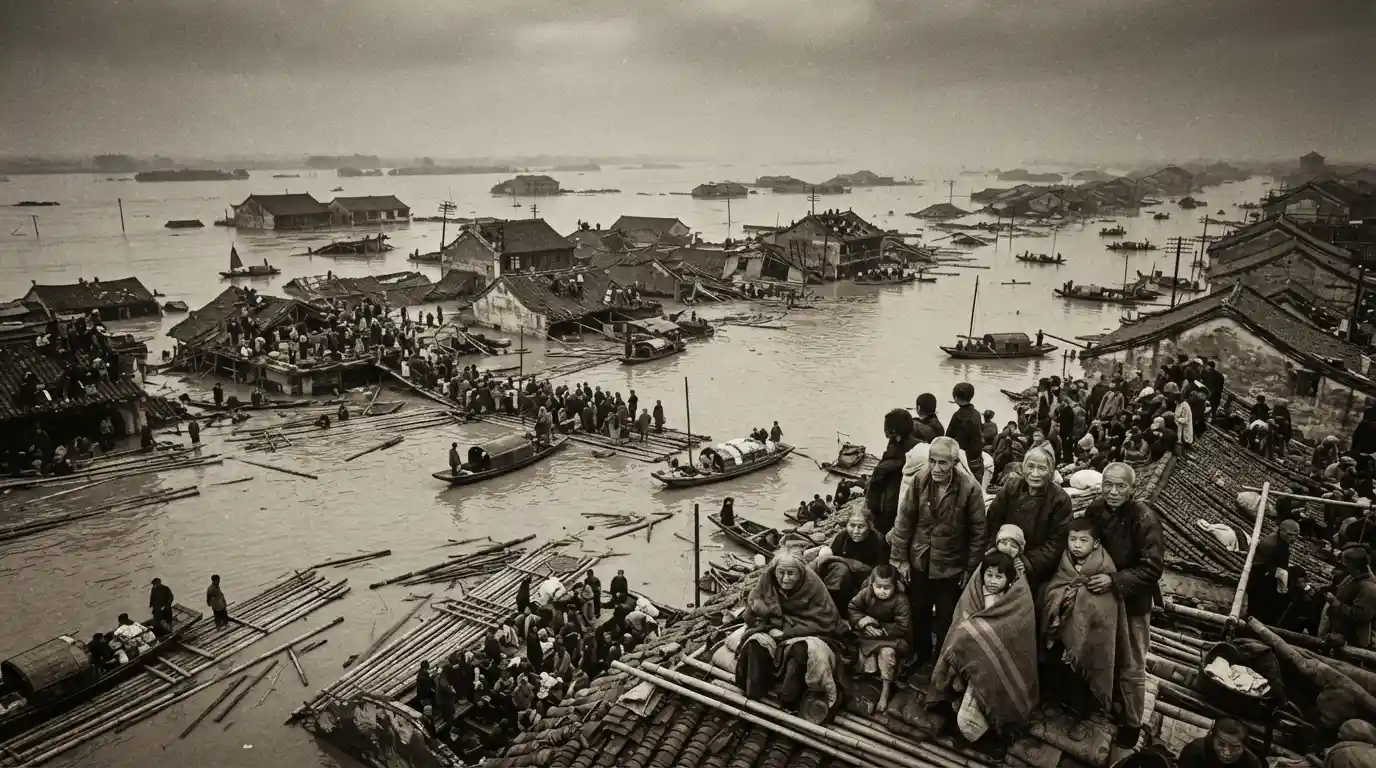
The 1931 Central China floods are the deadliest natural disaster in recorded human history (excluding pandemics and famines). Between July and November 1931, three major rivers—the Yangtze, the Yellow, and the Huai—overflowed at the exact same time.
- Cause: Two years of severe drought were followed by heavy winter snowstorms, spring thaws, and seven major cyclones in July alone.
- Submerged Area: Approximately 180,000 square kilometers (70,000 square miles) of land went underwater—an area roughly the size of England and half of Scotland combined.
- Water Levels: In the city of Hankou, the Yangtze River rose 16 meters (53 feet) above its normal level.
- Death Toll: While immediate drownings accounted for roughly 150,000 to 400,000 deaths, the resulting famine and waterborne diseases like cholera and typhus pushed the total death toll to between 2 million and 4 million people. Over 50 million people were affected or displaced.
2. The 1887 Yellow River Flood (China)
Known for centuries as “China’s Sorrow,” the Yellow River sits higher than the surrounding farmland because of silt buildup trapped between man-made dikes. In September 1887, days of heavy rain caused the river to breach its dikes near the city of Zhengzhou in Henan province.
- Submerged Area: The floodwaters spread rapidly across the flat plains of northern China, covering roughly 130,000 square kilometers (50,000 square miles).
- Impact: Eleven major cities and hundreds of villages were completely destroyed.
- Death Toll: Between 900,000 and 2 million people died from drowning, starvation, and disease, leaving another 2 million homeless.
3. The 1938 Yellow River Flood (China)
Unlike other disasters on this list, the 1938 Yellow River flood was caused intentionally by humans. During the Second Sino-Japanese War, the Chinese Nationalist government ordered the destruction of the river’s dikes at Huayuankou to halt the rapid advance of the Imperial Japanese Army.
- Submerged Area: The diverted river flooded 54,000 square kilometers (21,000 square miles) across three provinces, shifting the mouth of the Yellow River hundreds of kilometers south for the next nine years.
- Death Toll: While it temporarily slowed Japanese troops, the flood killed between 400,000 and 800,000 Chinese civilians and turned nearly 4 million people into refugees.
4. The 1975 Banqiao Dam Failure (China)
In August 1975, Super Typhoon Nina collided with a cold front over Henan province, dumping more than a year’s worth of rain in just 24 hours. The region recorded 1,060 millimeters (41.7 inches) of rain in a single day.
- The Collapse: The Banqiao Dam, designed to withstand a 1-in-1,000-year flood, could not handle the 1-in-2,000-year storm. On August 8, the dam burst, unleashing a wall of water 10 kilometers (6.2 miles) wide and 3 to 7 meters (10 to 23 feet) high traveling at nearly 50 kilometers per hour (31 mph).
- Chain Reaction: The wave caused 61 other downstream dams to collapse in a chain reaction.
- Death Toll: Roughly 26,000 people drowned immediately, and another 145,000 to 200,000 people died from subsequent epidemics and famine. Around 11 million people lost their homes.
5. The 1530 St. Felix’s Flood (Netherlands)
Before modern sea walls and dikes were engineered, the low-lying Netherlands was frequently battered by North Sea storm surges. On November 5, 1530—St. Felix’s Day—a massive storm surge overwhelmed the coastal defenses in Flanders and Zeeland.
- Impact: Large portions of the land were permanently swallowed by the sea, wiping out entire towns and drowning more than 100,000 people in a single day.
- Legacy: The event became known in Dutch history as Quade Saterdach (Evil Saturday) and forced the country to completely rethink its flood engineering.
6. The 1953 North Sea Flood (Netherlands & UK)
On the night of January 31, 1953, a severe European windstorm combined with a high spring tide to create a storm surge over 5.6 meters (18.4 feet) above mean sea level.
- Impact: Dikes failed across the Netherlands, Belgium, and the east coast of England. In the Netherlands, 1,365 square kilometers (527 square miles) of land flooded, forcing 72,000 people to evacuate.
- Death Toll: The flood killed 2,551 people total—1,836 in the Netherlands, 307 in the United Kingdom, 28 in Belgium, and over 200 on ferries at sea.
- Legacy: This disaster directly led to the construction of the Delta Works in the Netherlands and the Thames Barrier in London.
How Modern Floods Compare
Today, satellite weather tracking, early warning systems, and reinforced dams prevent death tolls from reaching the millions. Modern record-breaking floods are measured mostly by financial cost and displaced populations rather than fatalities:
- 2022 Pakistan Floods: Record monsoon rains and melting glaciers submerged one-third of the country—roughly 85,000 square kilometers (33,000 square miles). It affected 33 million people, killed 1,739, and caused $30 billion in damage.
- 2011 Thailand Floods: Heavy monsoon rains flooded 65 of Thailand’s 77 provinces, killing 815 people and causing $46.5 billion in economic damage by halting global manufacturing supply chains.